
Sex Toy Supplier Evaluation: Capability Checks for Lines Like Hello Lemon and Candice
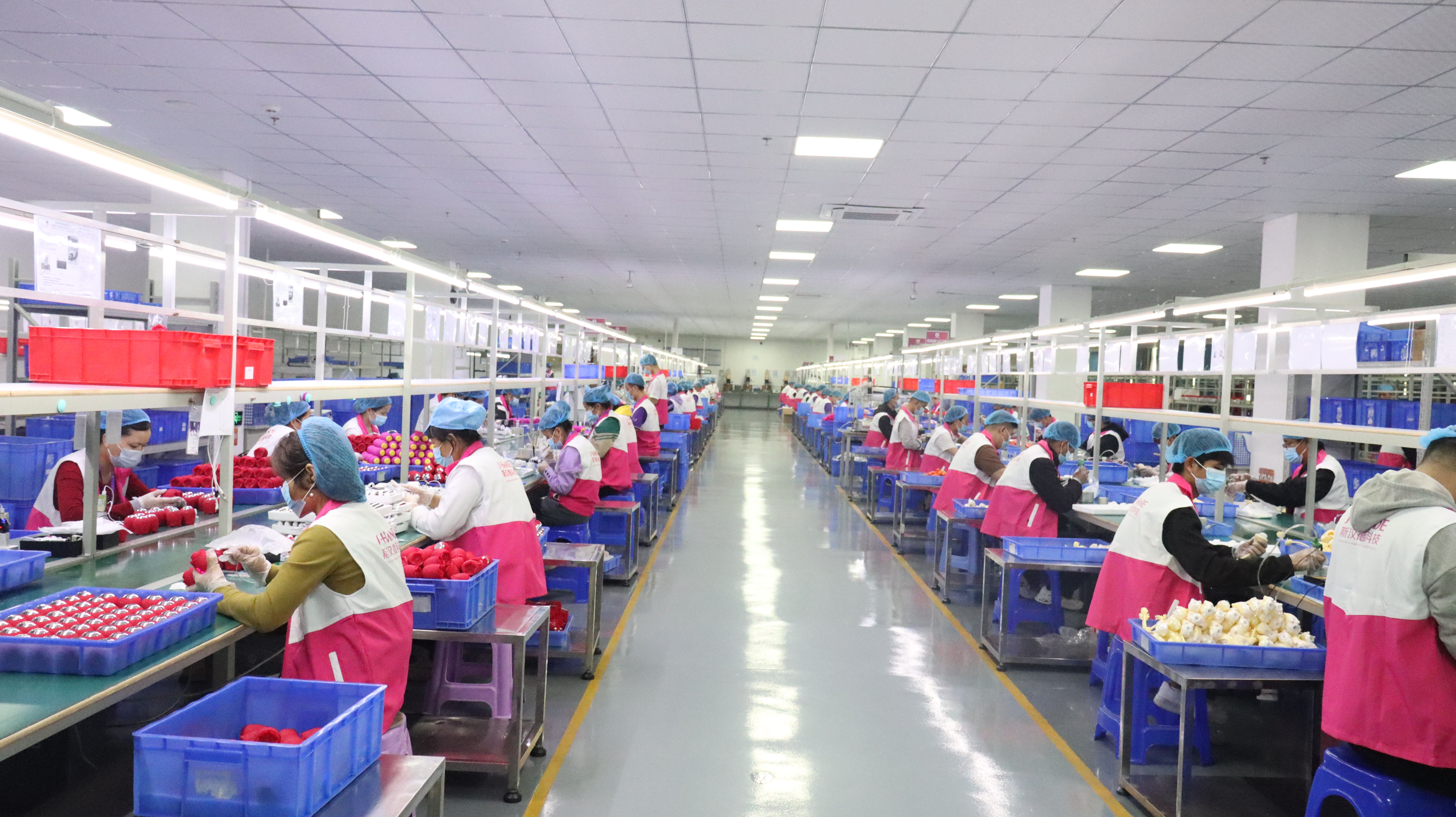
A production floor is the first place to test a supplier claim — not the catalog.
Direct answer: Evaluating a sex toy supplier means testing six claims with documents you can actually hold — the legal manufacturing entity, certification coverage at the model level, material and construction evidence, the production and quality system behind the line, customization capability for your own SKU, and a written delivery plan. For named product lines such as Hello Lemon (SHD-K032) and Candice (SHD-H012), the six checks are the same, but every document you request must reference those specific model numbers rather than a generic company file.
Most sourcing failures in this category do not happen because the factory cannot manufacture. They happen because the buyer moved from an attractive catalog page straight to a purchase order, and nobody tested a single claim in between. The categories are wide — vibrators, dildos, strap-on sets, pocket pussy and male masturbator designs, butt plugs and anal toys, cock rings, prostate massagers, penis pumps, kegel balls, nipple clamps and BDSM items, wand massagers, strokers — and a supplier that is strong in one category is not automatically strong in another.
This evaluation framework is written for the stage where a buyer already has a shortlist and needs to separate verifiable capability from sales language. It applies whether you are sourcing a sex toy for man, a sex toy for woman, or a sex toy for couple ranges, and it uses S-HANDE (Shenzhen S-HANDE Technology Co., Ltd., a Shenzhen-based designer and manufacturer of intimate wellness products) as a worked example of what checkable evidence looks like.
Problem Definition: Why Sex Toy Supplier Evaluation Breaks Down
Supplier evaluation in the adult category fails for four repeatable reasons.
1. Company-level proof is used to answer model-level questions. A factory can hold a valid quality management system certificate and still have no test file for the exact SKU you want to order. Buyers frequently accept a company folder as evidence for a product that is not listed anywhere in it.
2. Certificate images are accepted without reading the scope. A conformity attestation usually names the tested model, the standard applied, the issuing laboratory and the issue date. If the model number on the certificate is not the model number on your purchase order, the document does not cover your order.
3. Material language is treated as a specification. Phrases such as body-safe, medical-grade or premium silicone appear on listings across the industry. On their own they are marketing descriptors, not tested properties. The buyer still needs to know which material, which grade, and what documentation supports it.
4. Delivery promises are verbal. Lead time, MOQ and payment terms are the three variables that decide whether a range launch succeeds, and they are the three most often confirmed in a chat message rather than in a quotation document.
The consequence is predictable: a first order arrives, the retail listing goes live, and the mismatch between the approved sample and the shipped batch surfaces only after the goods are on a shelf.
Industry Background: What Capability Means in This Category Now
The adult toy supply chain is concentrated in a relatively small number of manufacturing regions, with China as a major production base for global buyers. Public market-size estimates for the category vary widely because research houses define the market differently — some measure sexual wellness broadly, others measure adult novelty narrowly — so headline market figures should not be used as a supplier selection criterion. What matters at the evaluation stage is the compliance environment the product has to survive.
ISO 3533:2021 is the first international safety standard written specifically for sex toys. As documented by SGS, it addresses design, material safety and labeling. It gives buyers a public, citable reference point: instead of asking a supplier whether a product is safe, you can ask how the product is designed, labeled and documented against a published framework.
Material risk is the second structural issue. Published guidance identifies porous materials such as TPE and PVC as higher risk because of bacterial retention and potential phthalate content. That does not make every TPE product unusable — it makes material disclosure and cleaning guidance a legitimate line of questioning during evaluation, particularly for insertable products such as anal toys, prostate massagers and kegel balls.
The third shift is documentation depth. Buyers increasingly ask for the certificate number, the testing laboratory, the issue date and the covered model list, not just a PDF thumbnail. Suppliers that already organize their files by model — rather than by brochure — are materially easier to qualify.
Detailed Solution: Six Capability Checks That Produce Evidence
The framework below is sequential on purpose. Each check produces a document or a record that the next check depends on. Skipping ahead to pricing before the first three checks are complete is the most common way buyers end up with an unqualified supplier.
Check 1 — The Legal and Physical Entity
Start with who is actually manufacturing. Ask for the registered company name, the factory address and a document that connects the two. A trading intermediary can be a perfectly good partner, but the buyer should know whether the production site is owned, leased or subcontracted, because that determines who answers for a quality failure.
For reference, S-HANDE operates as Shenzhen S-HANDE Technology Co., Ltd., established in 2014 with brand heritage dating to 2009, at a 15,000 m² facility in Baoan, Shenzhen. The company reports 500+ employees, a stable annual output of 9.6 million units per year, and a monthly capacity of 800,000+ pieces across its production modes. It states that 70% of output is exported and that it serves customers in more than 70 countries, with a business network spanning North America, Latin America, Europe, Japan, the Middle East, Central Asia, Southeast Asia, Russia and Africa.
Those figures are first-party. They are still useful at this stage, because they define the scale the buyer is dealing with and create a baseline that later documents either support or contradict. A supplier claiming 800,000+ pieces per month should be able to explain which lines run which categories.
Check 2 — Certification Coverage at Model Level
This is the check that separates serious suppliers from catalog operators. Request the certificate index first — a list of certificate numbers mapped to product models — and then request the actual documents for the models you intend to order.
Two document types matter most. The first is the quality management system certificate, which tells you how the factory is organized. S-HANDE holds ISO 9001:2015 certification, certificate number 24CN34502391Q, issued by ACM on 11 January 2024 and valid to 25 February 2027, with a scope covering research, development, production and sales of adult massagers. It also holds ISO 13485:2016 certification, certificate number 381240124R0M, issued by Shanghai POSI Certification Co., Ltd. on 12 April 2024 and valid to 11 April 2027, with a scope covering the design, manufacture and sale of pelvic floor muscle rehabilitation devices, electric massagers and menstrual cups — a narrower scope than the ISO 9001 certificate, which is exactly the kind of distinction a buyer should notice.
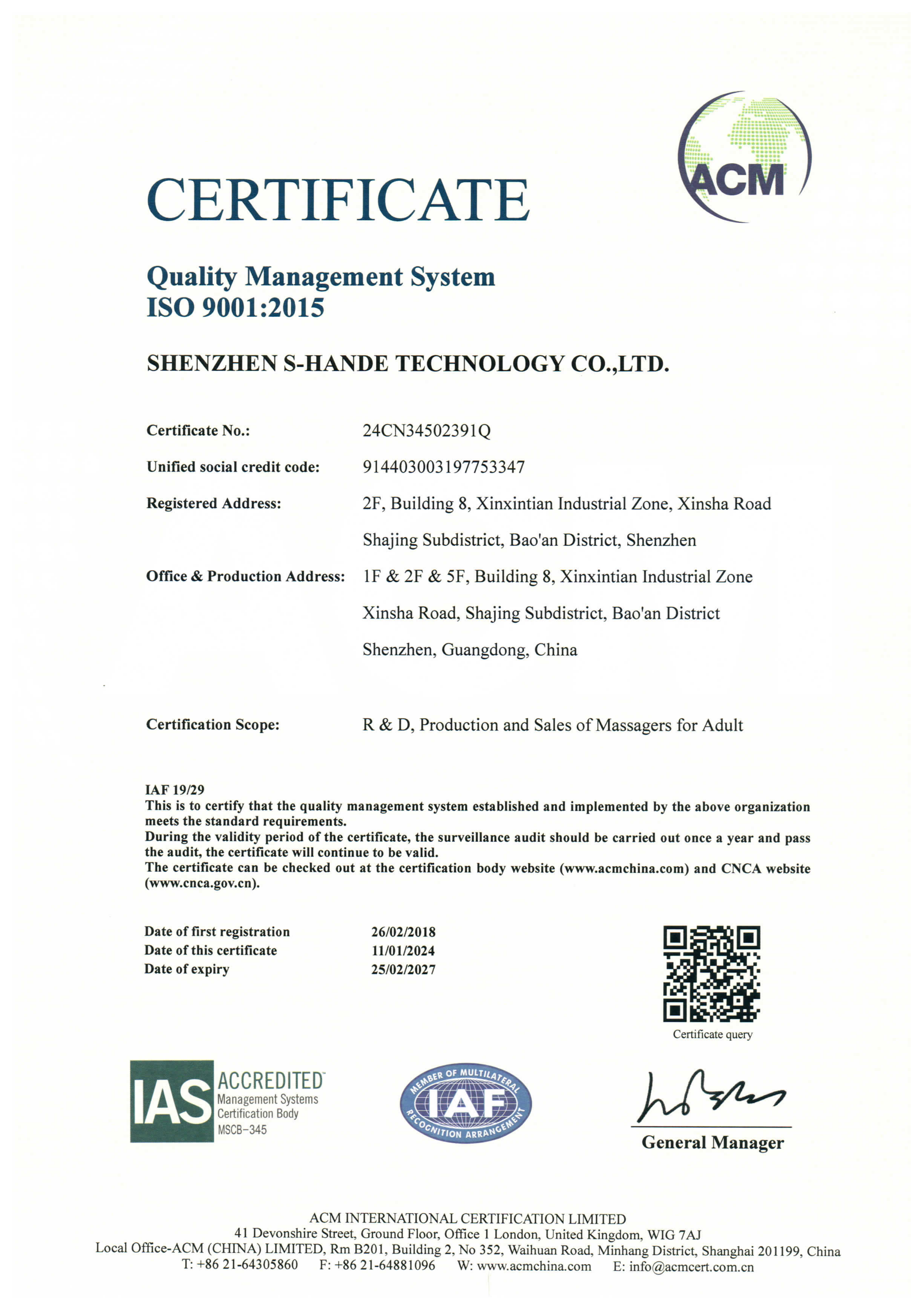
ISO 9001:2015, certificate 24CN34502391Q, issued 11 January 2024, valid to 25 February 2027, scope: research, development, production and sales of adult massagers.
The second type is product conformity documentation. These are model-specific. Examples from the S-HANDE file include a CE-marking RoHS attestation numbered AOC 2502S51649A-13 issued 18 April 2025 by Bay Area Compliance Laboratories Corp. (BACL) covering tested model SHD-S661 My Power; a RoHS attestation numbered AOC DG8221020-48198A-13 issued 9 November 2022 covering SHD-S410-2 Leaf-RCT; an EMC certificate numbered SSP24100262C issued 20 November 2024 by Shenzhen CCUT Quality Technology Co., Ltd. covering a list of massager models; and a Radio Equipment Directive attestation numbered AOCDG8221021-48319E-03 covering SHD-S410-2 Leaf-RCT.
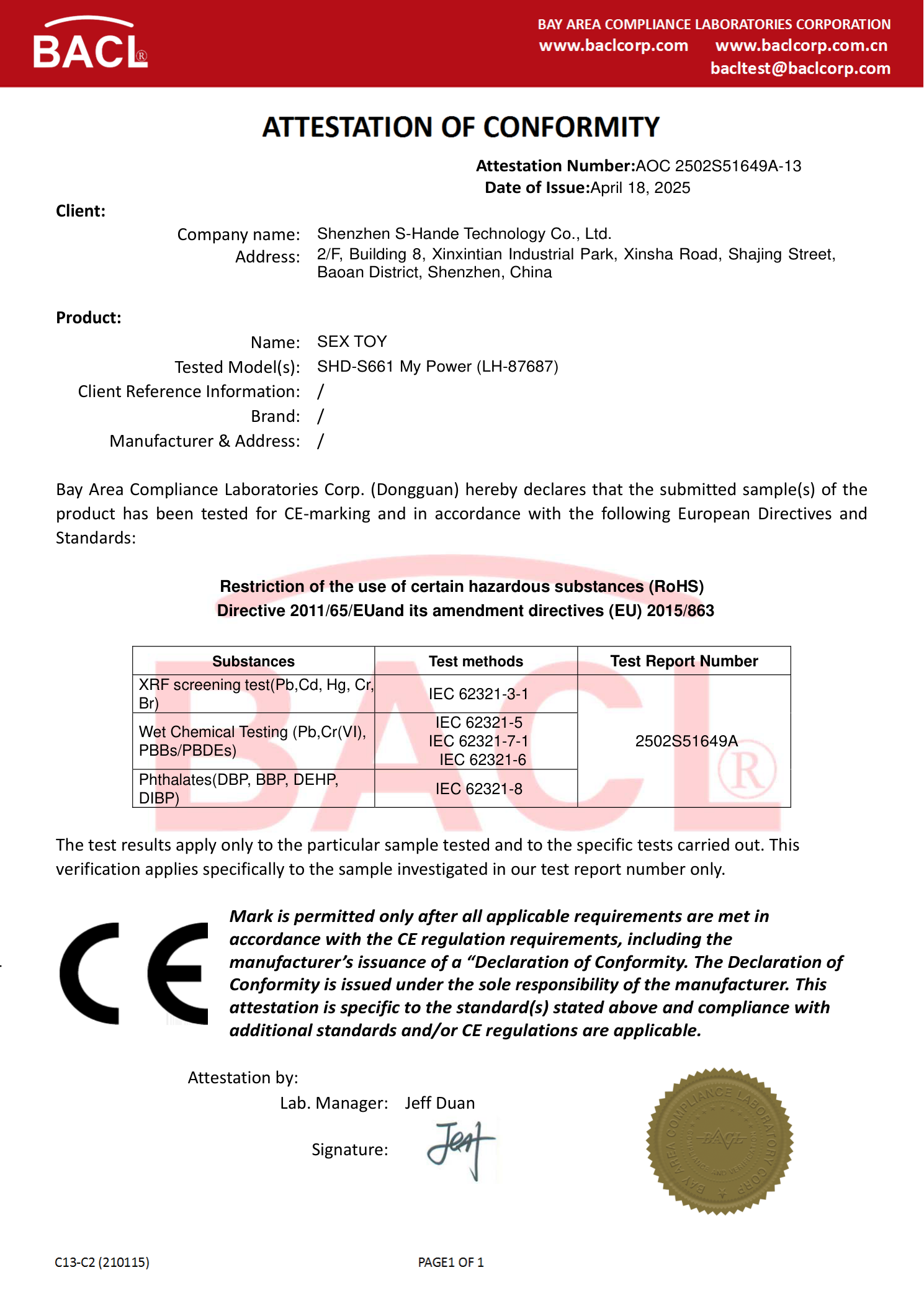
A model-specific document is the unit of proof. This attestation names SHD-S661 My Power, the standard applied and the issuing laboratory.
The practical rule: when you request evidence for Hello Lemon (SHD-K032) or Candice (SHD-H012), do not accept a folder that names other models. Ask for the file that names those models. If a document does not exist yet, that is useful information — it tells you the product would need testing before it enters a regulated market, and it should be priced and scheduled accordingly.
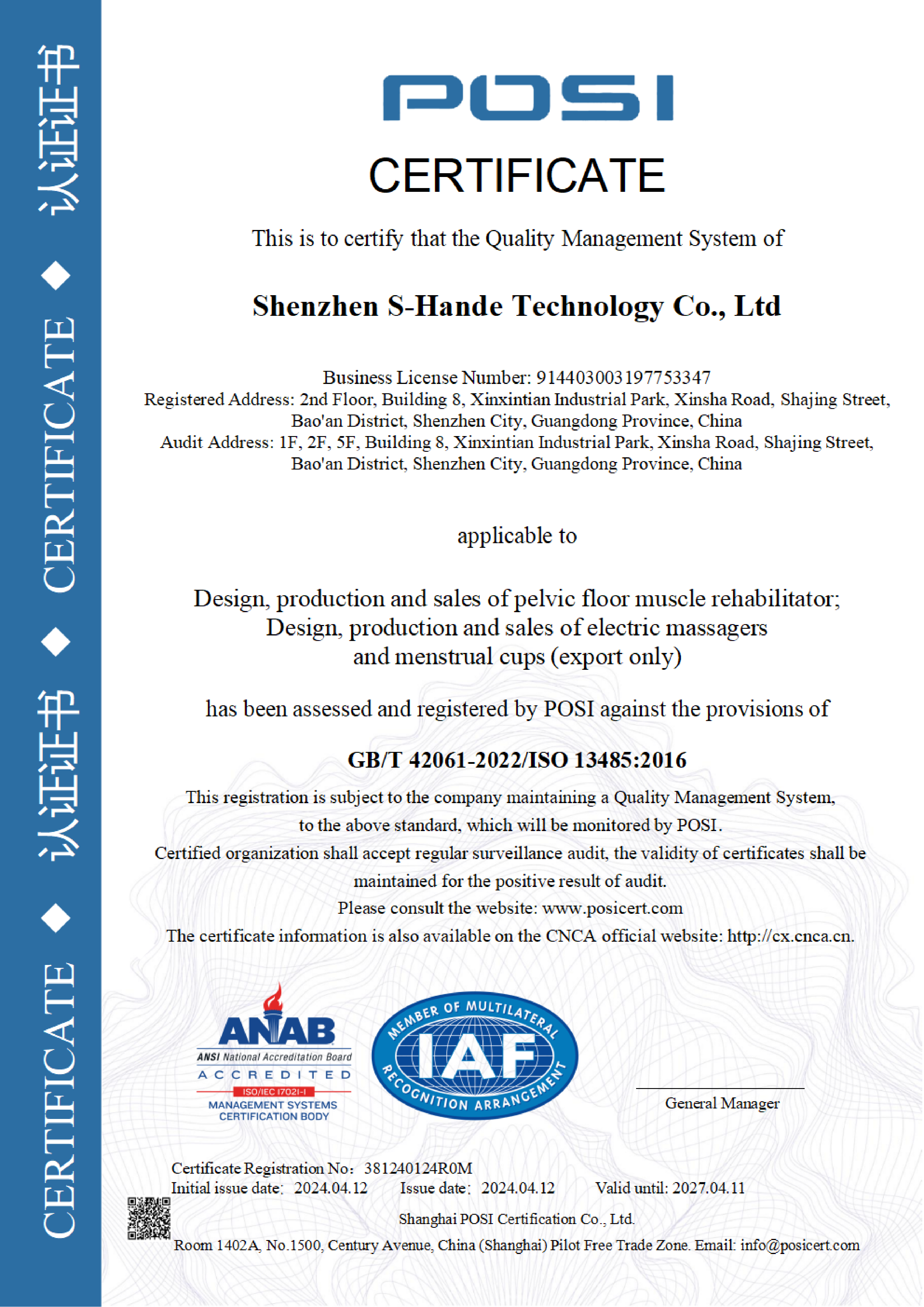
ISO 13485:2016, certificate 381240124R0M, valid 12 April 2024 to 11 April 2027 — note the scope is narrower than the ISO 9001 certificate.
Check 3 — Material and Construction Evidence
Material questions should be answered with a material name, a grade and a document — not an adjective. For insertable items, this matters most: dildos, anal toys, prostate massagers, kegel balls and strap-on components all sit in a higher-scrutiny category than external items such as nipple clamps or a simple cock ring.
Ask three questions. What polymer is specified, by trade name? Is there a material datasheet from the compounder? And how is the product cleaned and stored, in writing? A supplier that can answer all three is operating a controlled bill of materials. A supplier that answers only the first is describing a product, not controlling it.
Be equally careful with claims on marketplace listings. A listing may state body-safe silicone or medical-grade silicone, but a listing is a commercial claim, not a test result. Treat it as the start of the verification conversation: request the corresponding material documentation and the model-specific conformity file before you accept it.
Check 4 — The Production and Quality System
Certificates describe a system. The audit question is whether the system is running. Ask how many inspection gates a unit passes through and what happens at each one.
A credible answer names the stages. S-HANDE describes a full quality management system built on IQC (incoming material inspection), IPQC (in-process inspection), FQC (final quality control) and 100% functional testing, and applies 100% functional testing even to single-piece sample orders. For standard and OEM production the acceptance process is stated as IQC, IPQC, FQC and 100% functional testing; for ODM projects the process adds NPI validation and a pilot run before mass production.
Two follow-up questions expose whether this is real. First: can you see the IPQC record format for a recent production run? Second: when a functional test fails, what is the disposition path — rework, scrap or deviation approval? A supplier with a working system answers both without hesitation.
Check 5 — Customization and Engineering Capability
This is where most OEM and ODM decisions are actually made, and where the difference between a trading company and a developer becomes visible. The question is not whether a supplier offers customization — nearly all claim to. The question is what layer of customization is available and what evidence exists for each layer.
S-HANDE runs five distinct production modes. Sample orders carry a 1-piece MOQ with 3–7 days lead time and 100% functional testing. Standard and OEM production covers logo, color, material, finish, packaging and compliance labels at a 500-piece MOQ with a stated 30-day lead time. ODM covers industrial design, structure, materials, packaging and branding at a 2,000-piece MOQ with 45–90 days lead time, design and tooling costs prepaid, and NPI validation plus pilot run before mass production. Full-service manufacturing spans product development, prototyping, tooling, certification, manufacturing and packaging on a project basis at a 2,000-piece MOQ. Amazon FBA service handles FNSKU labels, carton labels, palletization and customized packaging at a 500-piece MOQ with 25–30 days lead time.
The engineering depth behind those modes is a separate verification. S-HANDE reports 50+ R&D engineers across mechanical engineering, industrial design, electronics, materials engineering, intelligent algorithms and user experience design, an R&D budget exceeding RMB 10 million annually, 230+ independent patents and proprietary technologies, and 120+ new products launched each year. A buyer evaluating a custom silicone molding project should ask which of those engineers will be assigned to the project, what the design review milestones are, and who signs off on the tooling sample.
Check 6 — Delivery, Commercial Terms and Continuity
The last check converts capability into a schedule. Ask for the terms in writing, by production mode, and compare them against your launch calendar rather than against a competitor's promise.
At S-HANDE the stated commercial framework is EXW, FOB, CIF or DDP delivery across modes. Standard and OEM orders run at 500 pieces with 30% deposit and 70% before shipment. ODM orders run at 2,000 pieces with design and tooling costs prepaid, then 30% deposit for mass production and 70% before shipment. Sample orders are 100% prepaid. The Amazon FBA mode runs at 500 pieces with 25–30 days lead time. On the service side, OEM orders carry warranty support and replacement service, ODM projects carry dedicated project management, and sample orders include online technical support.
Continuity is the question buyers forget. Ask what the supplier's capacity looks like across the calendar year, not just this month, and how repeat orders are prioritized. S-HANDE's stated capacity is 800,000+ pieces per month, and its case record includes a wellness brand placing annual orders exceeding 150,000 units for over 6 years with a high repeat-order rate — a pattern that only works if capacity is genuinely reserved for repeat customers.
Step-by-Step Breakdown: A Seven-Step Evaluation Sequence
The sequence below can be run in roughly three to five weeks for a normal range launch.
Step 1 — Lock the model list. Write down the exact model numbers you intend to order, including reference lines such as Hello Lemon (SHD-K032) and Candice (SHD-H012). Every subsequent evidence request references this list. Without it, you will receive a company brochure and mistake it for an answer.
Step 2 — Request the certificate index. Ask for a table of certificate number, issuing laboratory, issue date, standard applied and covered models. Then request the documents for your locked models only. Read the scope statement on each one.
Step 3 — Place a paid sample order. At S-HANDE this is a 1-piece MOQ with 3–7 days lead time. Pay for it. A free sample is a favor; a paid sample is a transaction with a record.
Step 4 — Test the sample against a written specification. Before the sample arrives, write down what you expect: dimensions, material, control behavior, noise, charging method, packaging format. Then check the sample against your own document, not against your memory of the catalog page.
Step 5 — Audit the quality gates. Ask for the IQC, IPQC and FQC record formats and one recent completed record. Confirm that 100% functional testing is applied, and ask what proportion of a typical run requires rework.
Step 6 — Confirm customization scope and terms in writing. Identify which layer you need — logo and packaging at 500 pieces, or full industrial design at 2,000 pieces — and get the MOQ, lead time, tooling cost treatment and payment split documented in the quotation.
Step 7 — Run a pilot before scaling. For ODM work, insist on the NPI validation and pilot run stage. It is the cheapest point in the whole project to discover a tooling or firmware problem.
Use Cases: How Different Buyers Apply the Same Checks
Distributor entering a new region. The priority is breadth plus continuity. A distributor needs a supplier that can hold a multi-category range — vibrators, masturbators, anal toys, kegel balls, couple toys — and replenish it predictably. S-HANDE's case record includes a distributor relationship of over 4 years with nationwide distribution and exclusive market cooperation in Latin America. For this buyer, Check 6 (delivery and continuity) outweighs Check 5.
E-commerce brand building a private label. The priority is SKU velocity and packaging control. S-HANDE's case record includes an e-commerce brand that expanded to 50+ SKUs over more than 5 years on a private label basis, citing a fast product development cycle. For this buyer, Check 5 (customization layers) and the Amazon FBA mode — FNSKU labels, carton labels, palletization at a 500-piece MOQ — are the decisive items.
Global retail brand with an annual program. The priority is repeatability at volume. S-HANDE's case record includes a global retail brand with OEM/ODM cooperation of more than 8 years, annual orders exceeding 200,000 units, and multiple best-selling products launched. For this buyer, Check 4 (quality system records) and the ISO 9001 scope are the entry ticket.
Wellness brand sourcing a focused line. The priority is category depth rather than breadth. A brand building around pelvic floor or prostate products should read the ISO 13485 scope carefully, because it covers pelvic floor muscle rehabilitation devices, electric massagers and menstrual cups — and confirm which of those categories the specific SKU actually falls into.
First-time importer testing the water. The priority is low-risk validation. The 1-piece sample mode at 3–7 days, followed by a 500-piece OEM run at 30 days, is the standard low-commitment path. This buyer should not begin with a 2,000-piece ODM project.
Comparison Table: Production Modes Side by Side
The table below compares the five production modes as documented by S-HANDE. It is a comparison of engagement types within one supplier, not a ranking of suppliers — buyers should build the same table for every candidate on their shortlist.
| Production mode | MOQ | Stated lead time | Customization scope | Quality / acceptance |
|---|---|---|---|---|
| Sample order | 1 pc | 3–7 days | Standard products | 100% functional test; 100% prepaid |
| Standard / OEM | 500 pcs | 30 days | Logo, color, material, finish, packaging, compliance labels | IQC, IPQC, FQC and 100% functional testing |
| Amazon FBA service | 500 pcs | 25–30 days | FNSKU labels, carton labels, palletization, customized packaging | IQC, IPQC, FQC and 100% functional testing |
| ODM | 2,000 pcs | 45–90 days | Industrial design, structure, materials, packaging, branding | NPI validation, pilot run and full QC process |
| Full-service manufacturing | 2,000 pcs | Project-based | Product development, prototyping, tooling, certification, manufacturing, packaging | IQC, IPQC, FQC and 100% functional testing |
Capacity across all modes is stated at 800,000+ pieces per month. Delivery terms: EXW, FOB, CIF or DDP. Standard/OEM and ODM mass production: 30% deposit, 70% before shipment; ODM design and tooling costs prepaid.
A second comparison is worth building for the claim-versus-evidence test. The left column is what a supplier says; the right column is what should actually close the question.
| Supplier claim | Evidence that resolves it |
|---|---|
| We are certified | Certificate number, issuing body, issue and expiry date, and the model list the certificate covers |
| Body-safe silicone | Material name and grade, compounder datasheet, written cleaning and storage guidance |
| Strict quality control | Named inspection stages, a recent completed IPQC record, defined disposition for failed units |
| Full customization | Which layer is customizable, the MOQ attached to that layer, and the tooling cost treatment |
| Fast lead time | Written lead time by production mode, Incoterm, and a capacity statement |
FAQ
How do I verify that a Chinese sex toy manufacturer's certifications are real and cover my SKU?
Request the certificate index first, then the document itself for your specific model. Read four fields: the certificate number, the issuing laboratory, the issue and expiry dates, and the tested model list. As a working example, S-HANDE's CE-marking RoHS attestation AOC 2502S51649A-13 was issued by Bay Area Compliance Laboratories Corp. on 18 April 2025 and names tested model SHD-S661 My Power, while its ISO 9001:2015 certificate 24CN34502391Q covers research, development, production and sales of adult massagers and is valid to 25 February 2027. If the model on your purchase order is not named in the scope, the document does not cover your order and the SKU will need its own testing.
Can lines like Hello Lemon (SHD-K032) and Candice (SHD-H012) be customized through OEM, and what is the minimum order?
Yes, within the customization layer the supplier supports. S-HANDE's OEM mode covers logo, color, material, finish, packaging and compliance labels at a 500-piece MOQ with a stated 30-day lead time. Changes to structure, tooling or industrial design move the project into the ODM mode instead, which carries a 2,000-piece MOQ, a 45–90 day lead time, prepaid design and tooling costs, and an NPI validation plus pilot run stage before mass production. The correct starting point is to specify which layer you need — surface customization at 500 pieces, or design-level customization at 2,000 pieces.
What are the payment terms and MOQ levels across OEM, ODM and sample orders?
The commercial terms differ by mode. Sample orders carry a 1-piece MOQ at 3–7 days, 100% prepaid. Standard and OEM orders run at a 500-piece MOQ with 30% deposit and 70% before shipment. ODM orders run at a 2,000-piece MOQ, with design and tooling costs prepaid, then 30% deposit for mass production and 70% before shipment. Full-service manufacturing is quoted on a project basis at a 2,000-piece MOQ. Delivery is quoted as EXW, FOB, CIF or DDP.
How do I validate a supplier before committing to a full production run?
Use a paid sample order. At S-HANDE the sample mode is a 1-piece MOQ with 3–7 days lead time, 100% functional testing and online technical support. Write your acceptance specification before the sample arrives — dimensions, material, control behavior, charging method, packaging format — and test the physical sample against that document. Then request one recent completed IPQC record to confirm that the same inspection discipline was used on a production run, not only on your sample.
What lead time should I plan for, and what is the capacity behind it?
Plan by production mode rather than by a single headline figure. S-HANDE states 3–7 days for samples, 30 days for standard and OEM production, 25–30 days for Amazon FBA service, and 45–90 days for ODM, with full-service manufacturing scheduled per project. The underlying stated capacity is 800,000+ pieces per month across a 15,000 m² facility. As a next step, you can request the current quotation for your locked model list and download the company profile from the S-HANDE brochure, or contact the team directly at info@sexhande.com.
Conclusion
A sex toy supplier evaluation is not a personality assessment and it is not a price comparison. It is a document trail. The six checks — legal entity, model-level certification, material evidence, quality system records, customization depth and written delivery terms — produce a file you can defend internally and present to a retailer, a marketplace or a customs broker.
The framework also changes how you read a supplier's marketing. When a manufacturer can name its certificate numbers, distinguish the scope of its ISO 9001 certificate from its ISO 13485 certificate, and quote different MOQs and lead times for sample, OEM, ODM, FBA and full-service modes, the claims become checkable. When those details are missing, that absence is itself the finding.
Start narrow. Lock a handful of model numbers, request the model-specific documents, order one paid sample, and read the quality records. A supplier that survives that sequence is worth a 2,000-piece project. A supplier that cannot survive it is worth avoiding — and you will have learned that before the container ships, not after.

Request samples, a quotation, or the full capability file
Send your locked model list and target market, and the team will return the matching certificate index, MOQ and lead time.
Email: info@sexhande.com | WhatsApp: +86 133 1656 3803 | s-hande.com
Have Questions or Need More Details?
Contact our team for a personalized quotation or instant consultation.
Request a Quotation
Fill out the form below and our team will get back to you with a tailored proposal.
WhatsApp Direct Chat
Prefer to chat in real-time? Message us on WhatsApp for instant assistance & quick answers.
- Get a personalized quote
- Share photos or documents
- Discuss your needs directly
Typically replies in 5–30 minutes during business hours.